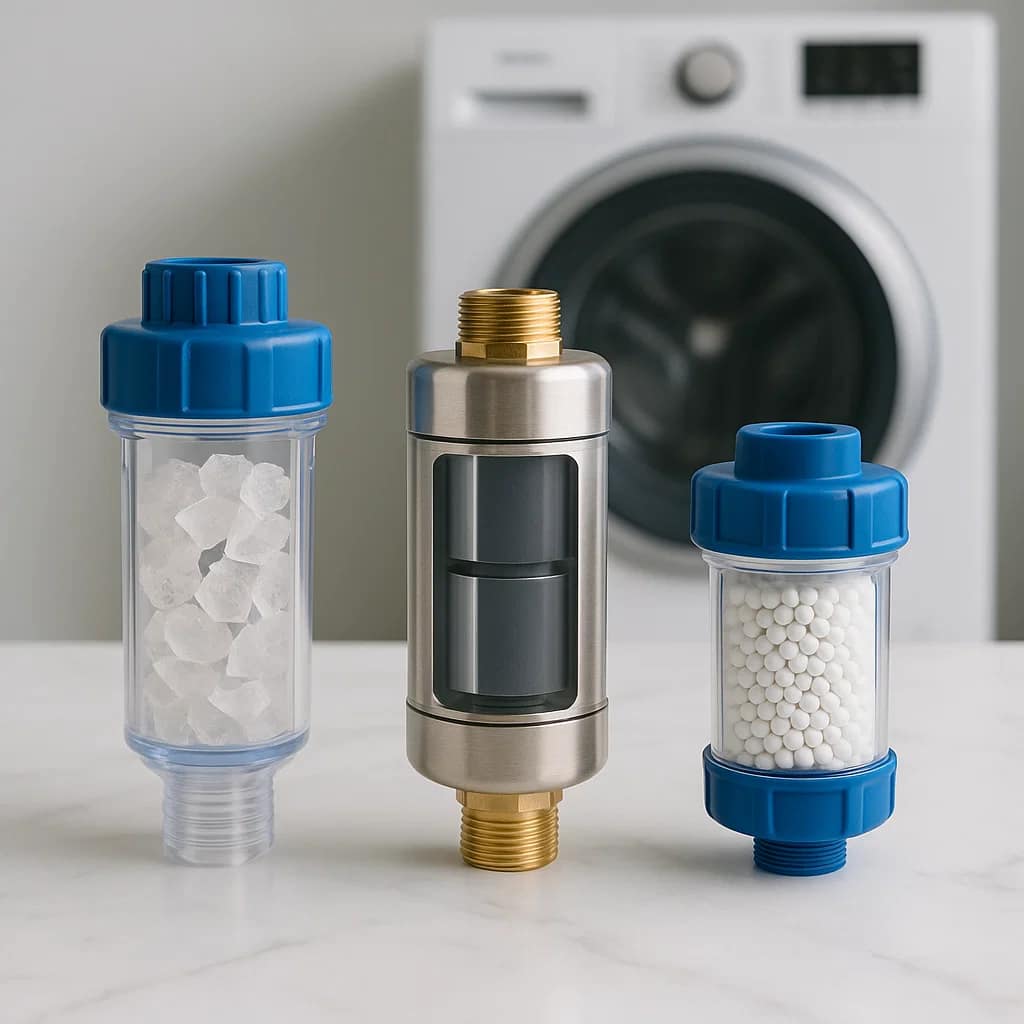
Which Type of Filter Softens Hard Water for Washing Machines?
November 3rd, 2025
Summary
What: Washing machine water filters are inline devices that prevent scale buildup by treating hard water minerals through chemical sequestration, magnetic conditioning, or ion exchange technology.
Who: Homeowners with hard water (above 60 mg/L) experiencing scale deposits, reduced washing efficiency, dingy clothes, and shortened appliance lifespan.
Why: Hard water reduces average washing machine lifespan from 11 years to just 7.7 years while decreasing cleaning performance and increasing energy costs.
When: Install immediately if you notice white residue on clothes, limescale in the drum, reduced water flow, or live in areas with water hardness above 120 mg/L.
How: Different filter types use polyphosphate crystals, magnetic fields, or ion exchange resins to prevent mineral deposits from forming inside your washing machine.
Introduction
Is your washing machine developing white crusty buildup inside the drum? Are your clothes coming out with chalky residue despite thorough washing? Hard water silently destroys washing machines from the inside out, cutting their lifespan by nearly 30%.
The minerals in hard water—primarily calcium and magnesium—deposit onto internal components, clog hoses, reduce heating efficiency, and create stubborn limescale that damages both your appliance and your laundry. These deposits accumulate relentlessly with every wash cycle, eventually causing expensive repairs or premature replacement.
This comprehensive guide reveals which water filter types actually soften hard water for washing machines. You’ll discover the science behind each technology, understand which solution matches your water hardness level, and learn installation steps that protect your appliance investment.
What Is Hard Water and How Does It Damage Washing Machines?
Hard water contains elevated concentrations of dissolved minerals that cause scale deposits and reduce appliance efficiency. Understanding the specific damage mechanisms helps you choose the right protection strategy.
Hard Water Classification Scale
Water hardness is measured in milligrams per liter, with anything below 60 mg/L considered soft water and anything above classified as hard:
Soft Water: 0-60 mg/L (0-3.5 grains per gallon)
Slightly Hard: 61-120 mg/L (3.5-7 gpg)
Moderately Hard: 121-180 mg/L (7-10.5 gpg)
Hard: 181-250 mg/L (10.5-14.5 gpg)
Very Hard: Above 250 mg/L (above 14.5 gpg)
Most municipal water supplies fall between 120-250 mg/L, placing them in the moderately hard to hard category.
Progressive Damage Timeline in Washing Machines
As water flows through washing machines, minerals deposit onto water lines, hoses, and valves, clogging them with scale and forming rust. The damage follows a predictable progression:
Month 1-6: Initial Buildup Phase
Thin mineral coating forms on heating element
Slight reduction in water flow through inlet valve
Detergent efficiency decreases by 10-15%
Month 6-18: Accumulation Phase
Visible scale on drum and detergent dispenser
Water flow reduction of 20-30%
Heating time increases, raising energy consumption
Average washing machine lifespan reduced to 7.7 years compared to 11 years with soft water
Expensive repairs frequently needed
Visible Signs Your Washing Machine Suffers from Hard Water
On the Machine:
White crusty deposits around detergent dispenser
Chalky buildup visible through drum door
Residue on rubber door seal
Reduced water pressure during fill cycle
On Your Laundry:
Clothes feel stiff and rough after washing
White spots or streaks on dark fabrics
Faded colors appearing prematurely
Towels losing absorbency and softness
Persistent musty odor despite cleaning
How Do You Test Your Water Hardness Level?
Accurate testing determines which filter type you need and helps track filter effectiveness over time.
Method 1: Water Hardness Test Kit (Most Accurate)
Purchase a comprehensive water test kit from hardware stores or online retailers for $15-30. These kits provide precise measurements:
Testing Process:
Collect water sample in provided container
Add reagent drops according to instructions (typically 5-10 drops)
Count drops until color change occurs
Each drop represents specific hardness level
Results accurate within 10 mg/L
Recommended Test Kits:
JNW Direct Water Hardness Test Strips
LaMotte 5860 Water Hardness Test Kit
Hach Total Hardness Test Kit
Method 2: TDS Meter Reading
Total Dissolved Solids meters measure mineral content electronically. While not exclusively for hardness, they indicate overall mineral levels:
Readings below 150 ppm suggest soft water
Readings 150-300 ppm indicate moderate hardness
Readings above 300 ppm confirm hard water
Cost: $15-40 for reliable digital meters
Method 3: Contact Your Water Supplier
Municipal water suppliers publish annual water quality reports containing hardness data:
Call customer service for current hardness levels
Request Water Quality Report (Consumer Confidence Report)
Check utility website for downloadable reports
Information provided free of charge
Method 4: Simple Soap Test (Qualitative)
This quick home test indicates hard water presence without precise measurements:
Procedure:
Fill clear bottle halfway with tap water
Add 10 drops liquid dish soap
Shake vigorously for 10 seconds
Observe results
Interpretation:
Abundant lather with clear water below: Soft water
Minimal lather with cloudy water: Hard water present
No lather with milky appearance: Very hard water
Which Filter Types Soften Hard Water for Washing Machines?
Five primary technologies protect washing machines from hard water damage. Each uses different mechanisms with varying effectiveness levels.
1. Polyphosphate Crystal Filters (Most Common)
Mechanism: Polyphosphate prevents calcium and magnesium from bonding and crystallizing by sequestering minerals rather than removing them.
Best For:
Moderate hard water (120-250 mg/L)
Budget-conscious homeowners
Front-load and top-load machines
Quick DIY installation
Key Features:
Cost: $25-60 for filter housing and initial cartridge
Cartridge lifespan: 4-6 months
Installation time: 15 minutes
No electricity required
2. Magnetic Water Conditioners
Mechanism: Magnetic conditioning of water helps soften hard water by altering the electromagnetic properties of minerals so they don’t form scale deposits.
Best For:
Mild to moderate hard water (60-180 mg/L)
Maintenance-free solutions
Space-constrained installations
Chemical-sensitive households
Key Features:
Cost: $30-80 one-time purchase
Lifespan: 3-4 years before replacement
No cartridge changes required
Attaches to inlet hose in minutes
3. Salt-Based Ion Exchange Softeners (Whole-House)
Mechanism: Resin beads coated with sodium ions attract and hold onto calcium and magnesium, removing them from water and releasing sodium through ion exchange.
Best For:
Very hard water (above 250 mg/L)
Whole-home water treatment
Maximum protection for all appliances
Long-term investment
Key Features:
Cost: $500-2,500 for whole-house system
Ongoing: $5-10 monthly for salt
Professional installation recommended
Removes hardness minerals completely
4. Multi-Stage Inline Filters
Mechanism: Combines sediment filtration, polyphosphate sequestration, and magnetic conditioning in single unit.
Best For:
Very hard water with sediment
Comprehensive protection approach
Areas with muddy or turbid water
Maximum filtration needs
Key Features:
Cost: $60-120 for complete system
3-stage filtration with sediment filter, antiscalant media, and magnets
Cartridge replacement: 4-6 months
Universal ¾-inch connector fitting
5. Electromagnetic Water Descalers
Mechanism: Electronic signals alter mineral crystal structure preventing scale formation.
Best For:
Tech-forward homeowners
Permanent installation preferences
Consistent hard water levels
No maintenance desired
Key Features:
Cost: $150-400
Requires electrical outlet
Mechanical device doesn’t require electricity to run for basic magnetic versions
No consumables or replacements
How Do Polyphosphate Filters Work for Washing Machines?
Polyphosphate filters are the most popular washing machine water treatment solution due to their effectiveness, affordability, and ease of installation.
The Chemical Sequestration Process
When dissolved in water, polyphosphate prevents formation of limescale by preventing calcium and magnesium from bonding and crystallizing. The process works in four stages:
Stage 1: Dissolution
Water flows through filter housing containing polyphosphate crystals
Crystals slowly dissolve at controlled rate
Polyphosphate molecules enter water stream
Stage 2: Sequestration
Polyphosphate molecules surround calcium and magnesium ions
Creates stable chemical complexes
Minerals remain suspended in solution
Stage 3: Protection
Long-term use creates thin protective film on surfaces, preventing corrosion and dissolving existing deposits
Protected surfaces resist new scale formation
Existing limescale gradually dissolves
Stage 4: Drainage
Sequestered minerals flow out with wastewater
No accumulation inside washing machine
Internal components remain scale-free
Installation Requirements and Process
Tools Needed:
Adjustable wrench or pliers
Teflon tape
Filter housing with ¾-inch connections
Polyphosphate cartridge
Step-by-Step Installation:
Locate washing machine water inlet (usually behind machine)
Turn off water supply valve completely
Disconnect inlet hose from wall connection
Wrap Teflon tape on male threads (3-4 wraps clockwise)
Install filter housing between wall valve and inlet hose
Hand-tighten connections then quarter-turn with wrench
Turn on water slowly checking for leaks
Run test cycle to verify proper flow
Maintenance Schedule and Cartridge Replacement
Monthly Checks:
Inspect connections for moisture or drips
Verify water flow remains strong
Check for visible residue in filter housing
Every 4-6 Months:
Replace cartridge every 6 to 9 months depending on water quality
Polyphosphates must never be exposed to more than 35°C
Hot water backflow can deplete crystals rapidly
Ensure proper check valve installation
Effectiveness Threshold:
Treatment becomes progressively ineffective at high hardness levels (35°f – 350 ppm of CaCO3 or more)
Not recommended for very hard water above 350 mg/L
Consider whole-house softener for extreme hardness
Does Not Reduce Total Hardness:
Polyphosphate treatment does not reduce total hardness of water
Minerals remain in water but prevented from depositing
TDS readings will not decrease
Are Magnetic Water Softeners Effective for Washing Machines?
Magnetic and electromagnetic water conditioners represent controversial yet increasingly popular washing machine protection methods.
How Magnetic Conditioning Works
Using magnetic conditioning of water, the device helps soften hard water by altering mineral properties through magnetic field exposure:
Scientific Principle:
Strong permanent magnets create magnetic field
Water flows through concentrated magnetic zone
Magnetic field alters electrical charge of mineral ions
Modified minerals less likely to bond and form scale
Effects temporary but sufficient for appliance protection
Two Types Available:
Permanent Magnetic Devices:
Contain powerful neodymium magnets
No electricity required
Mechanical device doesn’t require electricity to run
Lifespan: 3-4 years
Cost: $30-80
Electronic Electromagnetic Devices:
Generate electromagnetic pulses
Require electrical outlet
Adjustable frequency settings
More powerful than permanent magnets
Cost: $150-400
Installation and Maintenance
Simple Installation Process:
Install magnetic water softener onto washing machine’s inlet hose
Position device as close to machine as possible
Ensure tight fit around hose (may include mounting straps)
For electronic versions, plug into nearby outlet
No plumbing modifications required
Maintenance Requirements:
Virtually maintenance-free operation
No cartridges to replace
No chemicals to add
Occasional cleaning of exterior surface
Check mounting security every 6 months
Effectiveness Debate and Real-World Results
Manufacturer Claims:
Reduces limescale formation by 60-80%
Improves wash quality
Extends life of washing machine by removing harmful limescale and mineral deposits
No ongoing costs after purchase
Scientific Skepticism:
Limited peer-reviewed research supporting claims
Results vary significantly between installations
Water chemistry affects effectiveness
Some studies show minimal measurable impact
User Experience Reports:
Mixed reviews from actual users
Many report reduced visible scale buildup
Some users observe noticeable difference in wash quality and reduced metallic smell
Others see no significant change
Effectiveness appears related to specific water composition
Best Applications for Magnetic Softeners
Ideal Conditions:
Mild to moderate hardness (60-180 mg/L)
As supplementary protection with other methods
Space-constrained installations
Rental properties where permanent changes not allowed
Chemical-free preference
Not Recommended For:
Very hard water (above 250 mg/L)
Sole protection method in extreme conditions
Situations requiring guaranteed results
Commercial or heavy-use applications
Do Salt-Based Ion Exchange Softeners Protect Washing Machines?
Whole-house salt-based water softeners provide the most comprehensive hard water protection for washing machines and all other appliances.
The Ion Exchange Process Explained
At the heart of every salt-based water softener lies the principle of ion exchange, which involves replacing calcium and magnesium ions with sodium ions. This complete removal process differs fundamentally from sequestration methods.
Four-Stage Softening Cycle:
Stage 1: Hard Water Entry
Hard water enters softener tank where it encounters bed of resin beads
Beads coated with sodium ions carry negative electrical charge
Water flows through resin at controlled rate
Stage 2: Ion Attraction and Exchange
Resin beads with negative charge naturally attract positively charged calcium and magnesium ions
Mineral ions displace sodium from bead surface
Sodium released into water as minerals captured
Stage 3: Soft Water Delivery
Treated water contains sodium instead of hardness minerals
Through softening process, sodium is added to water at rate of about 8 mg/L for each grain per gallon of hardness
Softened water distributed to all household fixtures
Stage 4: Regeneration
Concentrated brine is pumped through resin to force calcium and magnesium off beads, recharging them with sodium ions
Displaced minerals flushed to drain
System ready for next softening cycle
System Components and Requirements
Main Components:
Mineral Tank:
Contains ion exchange resin beads
Minimum depth of resin should be no less than 24 inches above underdrain
Size determined by household water usage
Typical residential: 30,000-60,000 grain capacity
Brine Tank:
Stores salt solution for regeneration
Brine tank must be regularly refilled with salt
Capacity: 100-300 pounds of salt
Includes float mechanism for level control
Control Valve:
Meters water usage
Initiates regeneration cycles automatically
Metered water softeners count gallons that pass through and automatically regenerate when necessary
Electronic or mechanical operation
Installation Requirements:
Professional installation typically required
Install at main water line entry point
Electrical outlet for control valve
Drain access for regeneration wastewater
Floor space: approximately 2×3 feet
Advantages for Washing Machine Protection
Complete Mineral Removal:
Salt-based water softeners effectively reduce water hardness by removing calcium and magnesium ions
Zero scale formation in washing machine
Maximum appliance lifespan extension
Consistent soft water delivery
Performance Benefits:
Softened water prevents mineral deposits from accumulating inside appliances like washing machines
Detergent efficiency increases 50-60%
Clothes feel softer without fabric softener
Colors remain vibrant longer
Reduced energy consumption from efficient heating
Long-Term Cost Savings:
Eliminates individual appliance filters
Reduces detergent use by 50%
Extends washing machine life by 3-4 years
Decreases repair frequency
Protects all household plumbing and fixtures
Disadvantages and Considerations
Initial Investment:
High upfront cost: $500-2,500
Professional installation: $200-500
Total initial investment: $700-3,000
Ongoing Maintenance:
Ongoing cost of purchasing salt for brine tank can increase over time
Salt consumption: 40-80 pounds monthly
Monthly cost: $5-15 for salt
Approximately 50 gallons of water used to regenerate water softener
Health and Environmental Concerns:
Salt-based water softeners add sodium to water during ion exchange process
People on restricted sodium diets should account for increased intake through softened water
Brine solution can negatively impact environment when discharged into wastewater systems
Some municipalities restrict salt softener installations
Space Requirements:
Requires significant floor space
Not suitable for apartments or small homes
Basement or utility room installation ideal
What Common Mistakes Should You Avoid When Installing Filters?
❌ Mistake 1: Installing Filter After Washing Machine Inlet Valve
Why It’s Problematic: The filter must treat water before it enters the machine. Installing downstream provides zero protection.
✅ Correct Approach:
Install filter directly at wall connection point
Water must flow: Wall valve → Filter → Inlet hose → Machine
Verify filter positioned between supply and appliance
❌ Mistake 2: Forgetting Teflon Tape on Threaded Connections
Why It’s Problematic: Metal-to-metal threads create imperfect seals, resulting in persistent drips that damage flooring and promote mold growth.
✅ Correct Approach:
Wrap Teflon tape 3-4 times clockwise on male threads
Apply smooth pressure while wrapping
Extend tape slightly beyond thread end
Hand-tighten first, then quarter-turn with wrench
❌ Mistake 3: Ignoring Water Hardness Test Before Purchase
Why It’s Problematic: Different filter types work for specific hardness ranges. Wrong selection wastes money and provides inadequate protection.
✅ Correct Approach:
Test water hardness before buying filter
Match filter type to measured hardness level
Polyphosphate filters: 120-350 mg/L maximum
Very hard water (above 350 mg/L): Requires ion exchange softener
Why It’s Problematic: Excessive force cracks plastic housings, strips threads, and damages O-ring seals.
✅ Correct Approach:
Hand-tighten connections until snug
Use wrench for final quarter-turn only
Never force connections that don’t align easily
Replace damaged O-rings immediately
❌ Mistake 6: Using Polyphosphate Filters with Hot Water
Why It’s Problematic: Polyphosphates must never be exposed to more than 35°C as higher temperatures increase dissolution speed, depleting crystals rapidly.
✅ Correct Approach:
Install check valve preventing hot water backflow
Connect filter to cold water line only
Verify washing machine uses cold water inlet
For hot water washing, use whole-house softener instead
How Do Different Filter Types Compare in Performance?
Understanding performance differences helps you select the optimal solution for your specific situation.
Comprehensive Comparison Table
Filter Type
Hardness Range
Initial Cost
Monthly Cost
Effectiveness
Installation
Lifespan
Polyphosphate Crystal
120-350 mg/L
$25-60
$8-12
70-85%
DIY 15 min
4-6 months
Magnetic Conditioner
60-180 mg/L
$30-80
$0
40-60%
DIY 5 min
3-4 years
Multi-Stage Inline
100-300 mg/L
$60-120
$10-15
75-90%
DIY 20 min
4-6 months
Salt-Based (Whole House)
Any level
$700-3000
$5-15
95-100%
Professional
10-15 years
Electromagnetic
60-200 mg/L
$150-400
$2-5
50-70%
DIY 10 min
5-7 years
Performance Metrics Explained
Effectiveness Percentage:
Measures scale reduction compared to untreated hard water
Based on laboratory testing and user reports
Varies with water chemistry and hardness level
Higher percentages indicate better protection
Cost Analysis:
Polyphosphate Filters:
Lowest initial investment
Moderate ongoing cartridge costs
Best value for moderate hardness
5-year total cost: $300-400
Magnetic Devices:
Medium initial cost
No ongoing expenses
Controversial effectiveness
5-year total cost: $30-80
Whole-House Softeners:
Highest upfront investment
Low monthly operating costs
Maximum protection and longevity
5-year total cost: $1,000-1,500
Decision Matrix by Water Hardness
Soft Water (0-60 mg/L):
No filter needed
Standard maintenance sufficient
Optional: Basic sediment filter for turbid water
Slightly Hard (61-120 mg/L):
Recommended: Magnetic conditioner
Alternative: Polyphosphate filter (will last longer)
Minimal risk without treatment
Moderately Hard (121-180 mg/L):
Recommended: Polyphosphate filter
Alternative: Multi-stage inline filter
Protection important for appliance longevity
Hard (181-250 mg/L):
Recommended: Polyphosphate or multi-stage filter
Consider: Whole-house softener if budget allows
Essential protection required
Very Hard (Above 250 mg/L):
Recommended: Whole-house salt-based softener
Alternative: Heavy-duty polyphosphate (may be insufficient)
Inline filters inadequate for this hardness level
Case Study: Installing a Polyphosphate Filter System
Background
The Rodriguez family in Phoenix, Arizona noticed persistent issues with their 3-year-old Samsung front-load washing machine purchased in 2022.
Initial Challenge
Water Hardness: Municipal water tested at 220 mg/L (13 grains per gallon) – classified as hard water
Problems Experienced:
White chalky residue visible inside drum after each cycle
Clothes emerging with visible white spots on dark fabrics
Testing water hardness quarterly confirmed continued effectiveness
Challenges Encountered:
Initial installation took longer than expected (22 min vs. 15 min estimated)
First cartridge depleted faster than expected (5 months vs. 6-month rating)
Required adjustment period for detergent amounts (used too much initially)
Family Testimonial: “We should have installed this filter when we first bought the washing machine,” reported Maria Rodriguez. “The $45 investment has saved us hundreds in detergent costs alone, and our clothes have never looked better. The best part is knowing we’ve extended our washing machine’s lifespan by years.”
Maintenance Schedule Adopted
Monthly Tasks:
Visual inspection of filter housing for leaks or moisture
Check water flow pressure during fill cycle
Wipe exterior of filter housing
Quarterly Tasks:
Test water hardness with test strips
Inspect inlet hose connections for mineral buildup
Document filter performance
Every 6 Months:
Replace polyphosphate cartridge
Clean filter housing interior
Check O-ring condition
Verify proper water flow
Frequently Asked Questions
How does hard water affect washing machine performance?
Hard water reduces washing machine efficiency by creating scale deposits on heating elements, clogging valves and hoses, and interfering with detergent effectiveness. Mineral buildup increases energy consumption, causes component failures, and shortens average appliance lifespan from 11 years to 7.7 years.
What mistakes should I avoid when choosing a water softener?
Never install filters after the washing machine inlet valve—they must treat water before entry. Avoid choosing filter types without testing water hardness first, as polyphosphate filters work only up to 350 mg/L hardness. Don’t neglect regular cartridge replacement every 6-9 months, and never use polyphosphate filters with hot water above 35°C.
How long does it take to see results from water softeners?
Immediate protection begins with the first wash cycle after installation. However, visible improvements emerge gradually: existing scale starts dissolving within 2-3 weeks, clothes show better cleaning results within 1-2 weeks, and complete mineral deposit removal takes 2-3 months depending on buildup severity.
What tools do I need to install a washing machine water filter?
Basic installation requires an adjustable wrench or pliers, Teflon tape for threaded connections, and a towel or bucket to catch residual water. Most inline filters feature universal ¾-inch connections that attach directly between the wall valve and inlet hose, requiring no specialized plumbing tools.
Can water filters damage my washing machine?
Quality water filters installed correctly cause zero damage to washing machines. However, improper installation—such as over-tightening connections that crack housings, forgetting Teflon tape causing leaks, or neglecting cartridge replacement that allows scale formation—can create problems. Follow manufacturer installation instructions precisely.
How do I know when to replace my filter cartridge?
Polyphosphate cartridges require replacement every 6-9 months depending on water hardness and usage frequency. Warning signs include: return of white residue on clothes, visible scale formation in drum, reduced water flow pressure, and water hardness test results showing elevated mineral levels.
Are magnetic water softeners scientifically proven?
Magnetic water softeners remain controversial in scientific communities. While many users report reduced scale buildup and manufacturers claim 60-80% effectiveness, peer-reviewed research provides limited supporting evidence. Results vary significantly based on water chemistry composition, with some installations showing noticeable improvements while others observe minimal changes.
What’s the difference between water softening and water conditioning?
Water softening removes hardness minerals (calcium and magnesium) completely through ion exchange, reducing total dissolved solids. Water conditioning sequesters minerals using polyphosphate or alters their structure through magnetic fields, keeping minerals in water but preventing scale formation. Softening provides more complete protection for very hard water.
Do I need a whole-house water softener for my washing machine?
Whole-house salt-based softeners provide optimal protection but aren’t always necessary. For water hardness between 120-250 mg/L, inline polyphosphate filters offer sufficient washing machine protection at lower cost. Very hard water above 250 mg/L requires whole-house softening for adequate protection of all appliances.
How often should I test my water hardness?
Test water hardness quarterly (every 3 months) to monitor filter effectiveness and detect changes in municipal water supply. Annual comprehensive water quality tests help identify additional contaminants. Immediate testing is warranted if you notice sudden changes in washing results or visible scale formation.
Conclusion
Hard water silently destroys washing machines through relentless mineral deposits that reduce efficiency, increase repair costs, and cut appliance lifespan by nearly 30%. Protecting your investment requires understanding which filter type matches your specific water hardness level.
Key Takeaways:
Polyphosphate crystal filters provide excellent protection for moderate to hard water (120-350 mg/L) at affordable cost with simple DIY installation taking just 15-20 minutes
Salt-based ion exchange softeners deliver complete mineral removal for very hard water above 250 mg/L, protecting all household appliances while requiring higher initial investment
Testing water hardness before purchasing filters prevents wasting money on inadequate solutions, with simple test kits providing accurate measurements for $15-30
Proper installation and regular maintenance extend filter effectiveness, requiring cartridge replacement every 6-9 months for polyphosphate systems and monthly salt additions for ion exchange softeners
The washing machine water softening market continues evolving with improved filter technologies and more affordable whole-house systems. By implementing appropriate hard water protection today, you’ll extend your washing machine lifespan by 3-4 years, reduce detergent consumption by 30-50%, and eliminate scale-related repairs.
Make 2025 the year you take control of hard water damage. Your washing machine, your clothes, and your budget will benefit for years to come.
Table Of Contents
newsletter signup
Get expert appliance tips, maintenance guides, and exclusive repair discounts delivered to your inbox
Appliquix connects you with certified local appliance repair technicians across the US, Canada, Australia, and Europe. Fast, reliable, and affordable appliance repairs at your doorstep